 RSS Feed (xml)
Hi Dr Bradley,
I've already fixed my post and uploaded the images.
I did not delete any comments that you made. On Wednesday after I posted the assignment, I checked the blog many times on the day and made some changes. But I still saw "No comments". I actually never delete any comments.
Do I need to correct anything else from my assignment? Do I need to redo it?
Thank you!
Tuesday, August 12, 2008
Question about blog assignment chemistry

The Role of Phosphate Esters in Biochemistry (DNA and Cellular Processes) chemistry
The backbone of deoxyribonucleic acid (DNA) is composed of nucleic acids, which are made up of ribofuranoside units strung together by phosphate esters. These phosphodiester bonds (two ester bonds) create the DNA backbone.
This simple ChemSketch shows the linking of nucleotides in DNA via phosphate ester groups:
Phosphate esters are created when phosphoric acid and an alcohol combine. Here is an example with methanol (alcohol), which can form three esters based on how many moles of methanol are used:
In addition to its role in the backbone of DNA, phosphate groups play a biochemical role in ribosome-substrate interactions and the regulation of cellular processes. The regulation of their formation on key body proteins regulates these processes, and malfunctions in their regulation can result in cancer, diabetes, and even obesity.
Phosphate groups also play a major part in the bending of the DNA backbone, due to the repulsion of the negative charges. Other experimentation concerning the role of phosphate ester groups includes looking at their electrostatic contribution to the free energy of the bent DNA backbone as well as the synthesis of heparin-immobilized polyetherurethanes, whose side groups have hydrolysable ester groups (heparin being a synthetic anti-coagulent).
Here is reference one and reference two and reference three from CiteULink.
In addition, Chapter 11 and Chapter 23 from Wade provide substantial information on this topic.


anti-Markovnikov hydration of an Alkyne chemistry

This is en example of what we learned in class, the Markovnikov hydration of n-propyne (a terminal Alkyne) that produces a Ketone. Using ACS publications, i found an article that describes an ideal anti-Markovnikov hydration of the same compound, to produce an Aldehyde instead.
To induce this reaction, the catalyst cyclopentadienylruthenium is used in a 2-Propanol solvent at 100 deg C, with yields over 99% for this reaction, other Alkynes bearing over 90% for the most part.
full article
Nitroglycerine synthesis chemistry
This is a nitrate ester made by esterification. In this process, glycerols reacts with Nitric Acid under a catalyst of Sulphuric Acid at 300oC to yield an ester complex of glyceryl trinitrate otherwise known as nitroglycerine, and three water molecules. In this process, there has been formation of an ester bond (COO). This production is very crucial for medical purposes. Nitroglycerine is used to relieve angina, a condition when the heart isn’t receiving much oxygen. Also, Nitroglycerine was used in a study with yohimbine/l-arginine combination to see the treatment of erectile dysfunction in males. The metrics used in this study were the male’s systolic and diastolic blood pressures. This study created a correlation between the effects of erectile dysfunction with the inadvertent cause of coronary artery disease. Intravenous Nitroglycerine was used to help in the study with the chemical compositions with arginine. Here is a reference for this article on its uses.

Tutoring chemistry
The Drexel Learning Center is offering tutoring for organic chemistry students this term. If you find this to be useful share your experience here.
Synthesis of Ethylene Oxide as a fumigant chemistry
This shows the synthesis of ethlyene oxide which can be used as a fumigant for foods, textiles, soils and for sterilizing biomedical instruments. It readily diffuses through materials without damanging them. Its antibacterial effect is probably due to its ability to alkylate critical cellular enzymes.
Heres a link

repeating mistakes chemistry
Before you post take a look at the comments I made on all of the other students' posts. I see the same errors coming up in the last few posts. In order to get full marks you must:
1) make sure your molecules and reagents are big enough to view easily from http://chem242.blogspot.com. See the first few examples that I graded "full marks" to see how big is big enough
2) you must use CiteULike
3) ALL of the reference info needs to be present in CiteULike (authors, journal name, year, page, volume, title, abstract)
4) the single step reaction that you have in your scheme MUST be in the article you are citing
I will shortly stop giving this feedback repeatedly and just grade it accordingly at each deadline.
If any student has tips (especially for making molecules the proper size in Chemsketch) it would be great if you could record a 1-2 minute screencast of it. Just download the trial version of Camtasia, save as an avi and I'll give you instructions to upload.
Friday, August 8, 2008
Blog Picture Suggestions chemistry
Two things that I did to help add clarity to my images was:
1) In Flikr, before you obtain the URL click on the image which is bigger than the one that shows up in your album and then go to properties to obtain the URL. This image is larger to when Blogger formats it, the picture is more clear.
2) To make the picture even more clear: go into "Edit HTML" of your blog post when you edit it. Then find the line for your image that will look like this:
"http://photos18.flickr.com/22901961_b9fc681f83.jpg?v=0">="DISPLAY: block; MARGIN: 0px auto 10px; WIDTH: 320px; CURSOR: hand; TEXT-ALIGN: center" alt="" src="http://photos18.flickr.com/22901961_b9fc681f83.jpg?v=0" border="0" /
and delete the text in pink (width) from the HTML code. This will make the image a little more clear. If your image is too large though, it will extend out into the navigation on the right so make sure when you delete width that your image doesn't do that.
Addition of Grignard Reagents to Ketones chemistry
------------------------
This is an example of the reaction of a ketone with a Grignard reagent, which gives a tertiary alcohol. The paper presents a study of several different idol-3-ones reacting with Grignard reagents. Idol-3-ones are potentially useful intermediates in the synthesis of alkaloids and pharmaceutical agents.
Going one step further: due to the lack of stability in the tertiary alcohol, a rearrangement is observed on the alcohol molecule, creating a gain in resonance stabilization in the final molecule. The study examined a variety of conditions under which the rearrangement occurred, in order to recognize the most efficient one. It was determined that the rearrangement took place with great facility under acidic or basic conditions or was thermally induced.
full text
or
CiteULike Quick Reference


The dioxygenase-catalysed formation of vicinal cis-diols chemistry
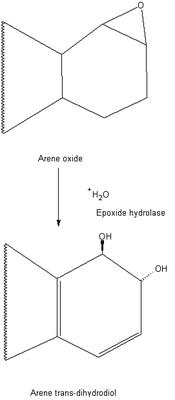
This is an example of the reaction of an epoxide ring reacting with water and and enzyme (epoxide hydrolase) to create a vicinal diol. The paper displays experiments with several different compounds and the role of mono- and di-oxygenase enzymes in arene
metabolism. The paper also displays a variety of intermediary or alternative pathways the the substrates can take to generate different, but useful products. The primary focus is on the impressive ability of bacterial oxygenases to catalyse the cisdihydroxylation
of a diverse range of arenes and alkenes to yield a single enantiomer.
Full Text
or
CiteULink Reference
First deadline grades chemistry
The first deadline for the blog assignment has now past. Everyone who posted has been graded. There is nothing you can now do to improve your grade on the first assignment. Learn from your mistakes and the mistakes of other students by reading my comments on all the posts to make the next deadline in 2 weeks.
One general comment: use a specific reaction of a specific compound that you find in the article. Avoid drawing general structure with R groups.
Wednesday, August 6, 2008
Creating Amphetamines by Tosylation of Alcohols chymistry
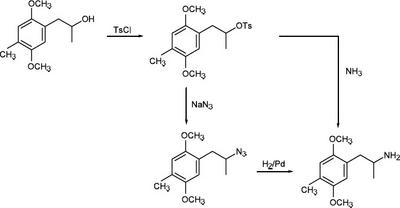
The picture above shows a few of the steps in the creation of amphetamines. In these steps, tosyl chloride is added to (2,5-dimethoxyl-4-methylphenyl)-2-propanol to create the tosylate. After this step, the reaction can proceed in one of two ways. If the chirality of the amphetamine is not important, ammonia is added to the tosylate to give 2,5-dimethoxy-4-methylamphetamine. This reaction has an 80% yield, but has a racemic mixture of products because it is thought to be an SN1 reaction. If the chirality is important, the tosylate is converted into an azide with sodium azide, then hydrogenated using a paladium catalyst to form 2,5-dimethoxy-4-methylamphetamine. Forming the amphetamine using this method gives a final yield of about 77%. The chirality of the original alcohol is inverted by the tosylation, so reacting an (S)-alcohol with the tosyl-azide-hydrogen sequence would give an (R)-amphetamine, and vice versa.
For the full text of the article describing this process, see this report.
Chap 9 UT map ready for testing chymistry
We have quiz 9 in Unreal Tournament 2004 map format available for testing. If you have UT2004 just download the map and textures here.
I'll make these maps available on the network shortly but for now you have to download and play on your computer.
You can play with or without bots (or other players). So if you just want to calmly explore select no bots and don't play on the network.
If you don't have UT2004 but still want to play let me know and we can make arrangements.
Please report any errors or problems as comments on the Edufrag blog on the post of the map you are playing.
This is an example of a student assignment done as a map instead of a blog post.a
A simple one-pot synthesis of β-alkoxy alcohols from alkenes chymistry
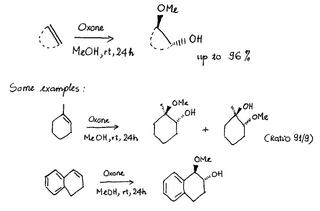
The main protocol for the synthesis of β-alkoxy alcohols is the alcoholysis of 1,2-epoxides. To synthesize epoxides, we can use oxone in the presence of transition metal complexes, or cyclodextrines, or via the formation of dioxiranes.
An application of this type of reaction is the synthesis of β-methoxy alcohols. It is done by the one-pot reaction of alkenes with oxone in methanol without any other catalyst.
Note: Oxone (2KHSO5·KHSO4·K2SO4) is the registered trademark from Du Pont.
General reaction and some examples are shown above.
For reference, please click on http://www.citeulike.org/user/hongan1985/article/258103
Methanol Synthesis and Dehydration Combined in a Single-Stage DME Synthesis Process chymistry
Dimethyl ether (DME) is a multipurpose clean fuel and chemical feedstock that can be produced from a wide variety of of sources and has a number of important applications. About 10,000 tons of DME are manufactured each year for uses in cosmetics and aerosal paint propellants. Its new use as a clean fuel source is gaining attention and research, as it contains no sulfur or nitrogen compounds, has a very low toxicity, and is not corrosive to metals. It can be stored and transported as a liquid at low temperatures
A single-stage, liquid phase synthesis process for DME in a slurry phase reactor system is efficient and facilatates heat removal. The combination of methanol synthesis and methanol dehydration reversible reactions in a single step is thermodynamically more favorable. The liquid phase operation allows for better heat management and higher yields of DME.
The first pictured reaction shows the methanol synthesized from carbon dioxide and it is combined with the second pictured reaction into the last pictured reaction, in which the synthesized methanol is dehydrated to produce DME.
See here for the CiteULike with the reactions and here for another journal article about DME. In addition, the catalytic synthesis of methanol is covered in Ch.10 of Wade and DME itself is discussed in Ch.14

Lucas Reagant chymsitry
The reaction seen above is an example of a substitution nucleophilic 1 reaction. The mild reaction conditions and high yields makes the Lucas reaction a convient way to be utilized in the industrial-scale preparation of alkyl chlorides from aliphatic alcohols. However, the wide use of the Lucas reagent in industrial settings is limited due to the cost of ZnCl2. This reaction proceeds rapidly and is needed for the fast demand and industrial use of menthyl chloride.

Williamson Synthesis of Ethers chymistry
The above reaction is an example of a Williamson synthesis of an ether. It is one the earlier steps in the reaction mechanism resulting in the octaethylene glycol derivative of 1,1,1,3,5,5,5-heptamethyltrisiloxane. Such an initial Williamson synthesis reaction had to be carried out so that later steps in the reaction—that is, ones involving material types not readily accessible—could successfully yield the derivative product. The resultant glycol derivative is an example of a defined surfactant. This particular journal article focused on the correlation between surfactant constituents and the effect on properties such as spreading performance.
The Williamson synthesis involves an SN2 reaction in which a halogen, sulfonyl, or sulfate group is replaced by an alkoxide ion, which can itself be prepared by a reaction of the alcohol with an active metal such as sodium or its hydride (i.e. NaH). The resultant alkoxide salt then reacts with the alkyl halide (must be primary) to produce an ether via the SN2 mechanism.
Other examples of Williamson synthesis of ethers can be found in this same reaction mechanism used to produce the surfactant. Article Link.

Preparation of Progesterone from Cholesterol chymitry
This is what I understand happens, following the process of production of progesterone, described on page 894, second column.
In the first two steps cholesterol is brominated in benzene, and oxidized in a solvent with acid permanganate(aq). In the last step the product is again debrominated using zinc dust.
The strong oxidizing agent potassium permanganate is used, as well as sulfuric acid. The article below describes the process of production of progesterone from cholesterol.
Progesterone has numerous physiological effects. Although primarily associated with the reproductive system, progesterone has multiple effects outside of it. This steroid hormone can act as an antiinflamatory agent, reducing the immune response; it can also assist in thyroid hormone action and bone building. Progesterone appears to prevent endometrial cancer (cancer involving the uterine lining) as well as breast cancer (1).
Article link

Catalytic Hydrogenation of an Acid chymistry
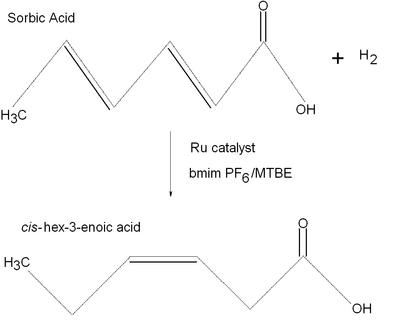
This reaction is an example of the catalytic hydrogenation of an acid in an ionic liquid similar to the reagents sodium metal/liquid ammonia discussed in lecture. This particular reaction has sorbic acid and hydrogen gas reacting with a ruthenium catalyst and a biphasic 1-butyl-3-methyl imidazolium hexafluorophosphate (bmimPF6)/methyl tert-butyl ether (MTBE) system to create cis-hex-3-enoic acid. The above reaction occurs with ~85% selectivity. The author of this paper was examining enantioselective hydrogenation in ionic liquids because this mechanism could provide a means for facile recycling of metal complexes of expensive chiral ligands. The author also studies some hydrogenation reactions that lead to the precursor of the antiinflammatory drug ibuprofen, the active ingredient in Advil.
For the full text click here.
Subscribe to:
Posts (Atom)