 RSS Feed (xml)
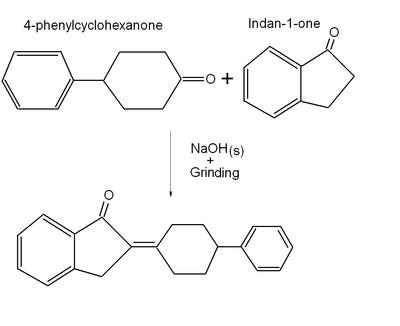
Recently there has been a paradigm shift away from using solvents in organic synthesis as solventless reactions can lead to improved outcomes, and more benign synthetic procedures, in for example an aldol condensation reaction as shown above. Sustainability is increasingly an important issue in broader context when you are talking about health, energy, and the sciences. Removing organic solvents in chemical synthesis is important in the drive towards benign chemical technologies. Organic solvents are high on the list of toxic compounds due to the problems in containing volatile compounds and the sheer large volume of them used in industry.
Some advantages of utilizing solventless reactions are that the compounds are often sufficiently pure to avoid extensive purification using chromatography, the reactions can be rapid, often reaching substantial completion in several minutes compared to hours in organic solvents, and the energy usage can be much lower.
For the full text click here.
Wednesday, August 6, 2008
Recent advances in solventless organic reactions: towards benign synthesis with remarkable versatility chemistry

Bimolecular Dehydration of 1-Pentanol to Di-n Pentyl Ether (DNPE) chemistry
Regulations controlling diesel exhaust become more exacting with each passing year. Accordingly, diesel fuel properties are constantly being analyzed in an attempt to further reduce fuel emissions. There are many options, most often refinement processes or improving the cetane number. Essentially, short and branched ethers (used in gasoline) have a good octane number but poor cetane number, while those ethers used in diesel are linear and have a comparatively long chain (ideally 9 or more carbons). Di-n pentyl ether (DNPE) has shown most effective in reducing emissions, and is also relatively simple to synthesize via the bimolecular dehydration of 1-pentanol on acid catalysts, as seen below.
However, the dehydration reaction results in quite a lot of byproducts, including other ethers. As such, a selective catalyst is required to favor production of DNPE by reducing the amount of alkenes. Increased selectivity can be accomplished via gel-type acidic resins at a reaction temperature of 150°C. The article I looked at analyzed the selectivity and reaction rate of the dehydration of 1-pentanol to DNPE using a gel-type resin at various temperatures and alcohol flow rates. Article Link.

Last Blog Assignment Deadline Over chemistry
All grades for the last blog assignment have been posted. It is now too late to add or change your posts.
I have been impressed with many of the posts. Most of you found relevant articles and extracted the information you needed. Several of the posts were about very practical things like environmentally friendly synthetic approaches, alternative fuels, breathalizer chemistry and the use of enzymes and biological agents to clean up pollutants.
One of the reasons I started this blog assignment is to help you understand how the reactions you are learning are used by chemists in the real world of research and industry. A side benefit is that I have learned some chemistry on each and every post. As a chemist you will never stop learning. What I am hoping is that in this class you have learned the skills to find the information you need to use chemistry productively in your career.
Another bonus is that other people from around the world are benefiting from your posts. Click on the SiteMeter button at the bottom of the blog then click on referrals to see how people are finding your posts.
I will be cleaning up the blog at the end of the term, removing unreadable or substantially incorrect posts. If you wish to keep your posts make sure to copy them before then. In Blogger you can copy a post from one blog to another easily. Just make sure you copy and paste in the "Edit HTML" view, not "Compose". Note that you can also convert the posts into Word. You may wish to do this also if you want to build an e-portfolio.
Welcome Winter 2006 class chemistry
Your starting point for this class is the wiki. I will use the blog this term only for announcements and this is where your extra credit blogging assignments get posted. See the assignments from previous terms in prior posts here and look at the comments to see my feedback and grading system.
First week update chemistry
1) Students who came to the workshops got all of their technical issues squared away and we worked on alkyne problems. A few students also worked on their extra credit assignments.
2) You should all have completed lecture 3 by this point (alkynes). If you are having any technical problems it is imperative that you deal with this at the next workshop on Wednesday.
3) We ran into a few glitches this week with accessing the Real Player lecture recordings but I posted a workaround on the wiki so that you would still have access through the guest account. Right now the Real Player lecture archive in WebCT is working fine. The PDFs associated with some of the lectures have been moved to Item 11 on the wiki. Not all the lectures are there yet but the ones for the first week are and the rest will be there shortly.
second week update chemistry
Just a reminder that you should now be at the end of Chapter 10 problems and quiz and have had any confusion resolved at the workshops or by emailing me. You should have all technical issues addressed by now.
The first test is coming up in 2.5 weeks.
Remember that the Friday workshops are in Matheson 109.
Class Vodcast available chemistry
Subscribe to the class screencasts on your video ipod by dragging the vodcast icon (from the class blog) into iTunes. Even without an ipod, you can view the screencasts from iTunes on your computer.
The quality is not as good as the Flash screencasts but it should be usable for the most part. Let me know how you find it.
The first 2 weeks are up now - more to follow.
Powerpoint and Problem set downloading chemistry
There seems to be a problem with downloading files from WebCT Vista.
You may now download the Powerpoints and the problem set pdf off of the class wiki (Items 4 and 12)
no workshop Jan 27 chemistry
There will be no workshop tomorrow Friday Jan 27, 2006. We'll resume on Monday.
Race on Monday - try to win an ipod chemistry
There will be an Edufrag Race using the educational version of Unreal Tournament on Monday Feb 13, 2006 during our workshop time at 9:00 in CAT 061. There will be 20 rooms in the maze on any topic from CHEM 241 and up to test 1 in CHEM 242.
I may include contributions from students in this class so this might be a good time to work on your extra credit due by Feb 17th.
The first student to make to the catroom has an equal chance of winning one of the following:
- 30Gig video ipod
- molecular model kit
- book
- consolation mystery prize
Hock Process in the Manufacture of Phenol chemistry
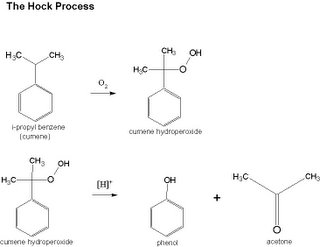
Phenol is more important than most people realize. It can be found in many consumer products including aspirin, head lights, gas tanks, billiard balls, nylon, wintergreen gums, Pepto Bismol, deodorant and more. A side product in the manufacture of phenol is acetone which is also used in the private sector in plastics, solvents, and more.
The high-yield manufacture of phenol uses the concepts of peroxidation and cleavage. Cumene (i-propyl benzene) is oxidized by exposure to air to temporarily produce cumene hydroperoxide. The cumene hydroperoxide is simply cleaved at the top of the benzene ring using an acidic catalyst to produce the two usable products of phenol and acetone. The catalyst is extracted and the phenol/acetone mixture is fractionated and purified. Under optimal conditions, 1.31 tons of i-propyl benzene (cumene) will produce 1 ton of phenol and 0.615 tons of acetone. The end-product phenol purity is at 99.99 wt % with total impurities of only 60 ppm. This process is termed the Hock process after being discovered by Hock and Lang in 1944. This process was ideal since both products were useful and relatively pure. Modern demand, however, for phenol is increasing at a higher rate than acetone. This means that the future may classify acetone as a partial waste product. More information on the Hock Process of manufacturing Phenol can be found here which expands on the Benzene-Free Synthesis of Phenol or here which discusses Selective decomposition of cumene hydroperoxide into phenol and acetone by a novel cesium substituted heteropolyacid on clay.
Feb 13 2006 Race chemistry
Today's edufrag race is available for download here.
Nick was the winner in 6 minutes. He drew the consolation prize (cat keychain). The ipod video will be up for grabs at the next race - we'll try for Friday.
Fischer Esterification: 2-ethylhexyl benzoate chemistry
Fischer esterification can be a time-consuming process, requiring days for a reaction to reach equilibrium. In this article, researchers developed a way to hasten this process by using a specially designed microwave to heat the reaction quickly and evenly and at an increased pressure. In order to test the efficiency of the device, they synthesized 2-ethylhexyl benzoate from benzoic acid and 2-ethylhexanol as shown below.
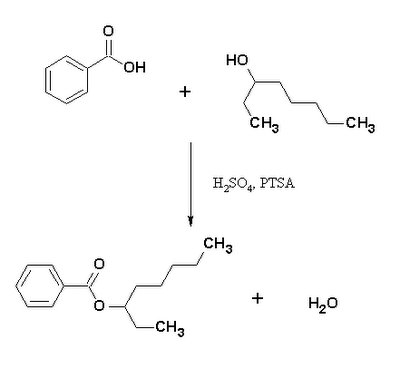
Sulfuric acid as well as para-toluene sulfonic acid (PTSA) were used to catalyze the reaction. In order to shift the reaction towards the products, a large excess of 2-ethylhexanol was used and the water produced was constantly removed. One of the disadvantages of Fischer esterification is that dehydration can also occur, resulting in unwanted ether and alkene products. Because of this, the temperature and catalyst concentration must be carefully monitored. The researchers were able to show that microwave heating causes no ill effects on the reaction and reduces the time required to a matter of minutes while still producing a high level of the desired product.
Feb 17 2006 race chemistry
This morning's Unreal Tournament race was won by Raymond in 8 minutes.
He won a book - the video ipod is still up for grabs.
Attend the next race Friday at 10:00 in Matheson 109 for a chance to win it.
next workshop chemistry
There will be no workshops this week until Monday Feb 27, 2006.
We'll also have another Unreal Tournament race on that day, covering the basics from CHEM241 and possibly anything in CHEM 242 up to and including NMR. The video ipod is still available as a prize.
Of course, I am also there to help with the class material, as usual. Generally students find NMR to be a little harder than the rest of the material so don't procrastinate coming to the workshops for help with that.
iPod won today chemistry
Louie won the video ipod in this morning's race in an impressive 4 minutes.
I think all of the NMR concepts we covered in this class are in there so you may want to try this one to practice for the test.
Lets do another race on Friday, although I can't promise there will be another ipod available.
frustrated winner chemistry
Nick won this morning's race in 10 minutes. This is his third win and he drew the molecular model set. The only prize left for him to win is the video ipod, since I don't give out the same prize twice to the same person. We'll do the final race of the term on Friday March 17, 2006.
This maze is all about IR and NMR and is a good way to review the material for the test and exam.
Exam Quiet Time Reservations chemistry
Sunday March 19th Room B-103 3:00-9:00 pm
Tuesday March 21st Room C-104 3:00-9:00 pm
Room B-103 has been reserved on Monday March 20th and Wednesday March 22nd from
4-9 pm
The Chemistry Behind Lightsticks chemistry

Almost everyone has seen a lightstick. A lightstick is a plastic tube with a glass vile inside it. When the tube is bent, the vial breaks allowing the chemicals to mix and react. The colorfully glowing sticks utilize a chemical process called chemiluminescence where energy is released in the form of light. The most common lightsticks use chemiluminescence with colored tubes to provide the desired color.
This process is not caused by heat and may not produce heat, but the speed of reaction is still dependence on environmental heat. The colder the environment, the slower the reaction and will glow longer.
Lightsticks have three parts. There are two chemicals that react to release energy which is converted to light. Usually, commercial lightsticks utilize the reaction between hydrogen peroxide and acetonitrile. When the glass vile is broken and the two chemicals are mixed, it will release enough energy to excite the electrons in the oxygen to cause the electrons to jump to a higher energy level and then fall back releasing light.
Specifically, the hydrogen peroxide oxidizes the acetonitril eventually forming excited oxygen. This decomposes and releases the energy as light as can be seen stepwise above.
More on chemiluminescence can be found here on “A Chemiluminescence Reaction between Hydrogen Peroxide and Acetonitrile and Its Applications.”