 RSS Feed (xml)
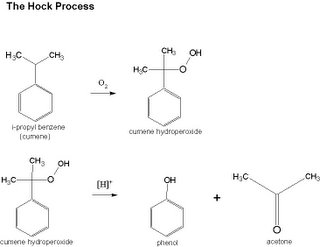
Phenol is more important than most people realize. It can be found in many consumer products including aspirin, head lights, gas tanks, billiard balls, nylon, wintergreen gums, Pepto Bismol, deodorant and more. A side product in the manufacture of phenol is acetone which is also used in the private sector in plastics, solvents, and more.
The high-yield manufacture of phenol uses the concepts of peroxidation and cleavage. Cumene (i-propyl benzene) is oxidized by exposure to air to temporarily produce cumene hydroperoxide. The cumene hydroperoxide is simply cleaved at the top of the benzene ring using an acidic catalyst to produce the two usable products of phenol and acetone. The catalyst is extracted and the phenol/acetone mixture is fractionated and purified. Under optimal conditions, 1.31 tons of i-propyl benzene (cumene) will produce 1 ton of phenol and 0.615 tons of acetone. The end-product phenol purity is at 99.99 wt % with total impurities of only 60 ppm. This process is termed the Hock process after being discovered by Hock and Lang in 1944. This process was ideal since both products were useful and relatively pure. Modern demand, however, for phenol is increasing at a higher rate than acetone. This means that the future may classify acetone as a partial waste product. More information on the Hock Process of manufacturing Phenol can be found here which expands on the Benzene-Free Synthesis of Phenol or here which discusses Selective decomposition of cumene hydroperoxide into phenol and acetone by a novel cesium substituted heteropolyacid on clay.
Wednesday, August 6, 2008
Hock Process in the Manufacture of Phenol chemistry

Feb 13 2006 Race chemistry
Today's edufrag race is available for download here.
Nick was the winner in 6 minutes. He drew the consolation prize (cat keychain). The ipod video will be up for grabs at the next race - we'll try for Friday.
Fischer Esterification: 2-ethylhexyl benzoate chemistry
Fischer esterification can be a time-consuming process, requiring days for a reaction to reach equilibrium. In this article, researchers developed a way to hasten this process by using a specially designed microwave to heat the reaction quickly and evenly and at an increased pressure. In order to test the efficiency of the device, they synthesized 2-ethylhexyl benzoate from benzoic acid and 2-ethylhexanol as shown below.
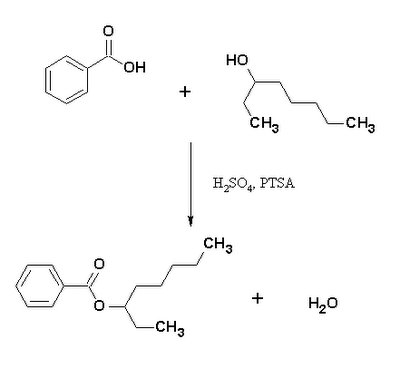
Sulfuric acid as well as para-toluene sulfonic acid (PTSA) were used to catalyze the reaction. In order to shift the reaction towards the products, a large excess of 2-ethylhexanol was used and the water produced was constantly removed. One of the disadvantages of Fischer esterification is that dehydration can also occur, resulting in unwanted ether and alkene products. Because of this, the temperature and catalyst concentration must be carefully monitored. The researchers were able to show that microwave heating causes no ill effects on the reaction and reduces the time required to a matter of minutes while still producing a high level of the desired product.